
Google just lost roughly $500 billion in market value. Is AI undermining the advertising business that made Google so profitable? And what does that mean for businesses paying for search ads?
On October 29, 2026, Alphabet, Google’s parent company, fell 12.64% in one trading session. Roughly half a trillion dollars in market value disappeared.
That’s an extraordinary number. But I think the more interesting story is what happened underneath it.
Google is putting AI into Search. People are also asking ChatGPT, Gemini, Claude, and Perplexity questions they might previously have typed into Google. And the way advertising fits into all of this is still being figured out.
I’ve been thinking about this since writing Your Next Customer Might Never Visit Your Website.
Here’s the uncomfortable question: what if Google is building a better search experience that makes its traditional advertising business less valuable?
Google Didn’t Actually Have a Bad Quarter
Alphabet reported $127.6 billion in revenue for the third quarter of 2026, up 25% from a year earlier. Google Search and related advertising revenue reached approximately $63.3 billion, up 12%.
Those aren’t the numbers of a company whose customers have suddenly disappeared.
But Search revenue growth had slowed from around 17% in the prior quarter. Alphabet also spent $51.4 billion on capital expenditures in Q3, largely to support technical infrastructure, and reported negative free cash flow of approximately $9.1 billion. That cash figure reflected more than AI spending alone, including a major European Commission fine payment and inventory investment.
The market was reacting to slower than expected growth in important areas and the extraordinary cost of building the next version of Google. It wasn’t simply voting against AI.
Then, during the October 28 earnings call, Google’s Chief Business Officer, Philipp Schindler, acknowledged something that caught my attention.
The strong growth in AI Mode queries was affecting Search revenue growth because those queries were generating less advertising revenue than traditional searches.
He also said foreign exchange was the single largest reason Search growth slowed compared with the previous quarter. Advertising spending patterns in particular industries mattered too.
That’s an important distinction. AI search was a factor. It wasn’t the only factor, and Google did not say people had stopped using Search.
In fact, Google said its annual search query growth rate was the highest in five years.
Which makes the dilemma more interesting: more questions, but a changing business model for making money from those questions.
People Aren’t Just Googling Things Anymore
Think about how you looked for something a few years ago.
You’d search Google. Open several results. Compare prices and reviews. Close some tabs. Open them again. Eventually make a decision.
I still do that.
But now I’ll also ask ChatGPT or Claude to compare options, explain the tradeoffs, or narrow down what I’m actually looking for.
I’m not necessarily asking for ten links. I’m asking for help making a decision.
And this behavior is becoming ordinary.
In a June 2026 Pew Research Center report, 42% of U.S. adults said they used AI chatbots to search for information. Forty four percent reported using ChatGPT, compared with 34% in the prior year’s survey.
That does not mean 42% of Google’s searches have moved elsewhere. It measures people who have used chatbots for that purpose, not search market share.
But it means assistants are becoming another place where purchasing decisions begin.
Sometimes the question isn’t “Which website should I visit?”
It’s “What should I do?”
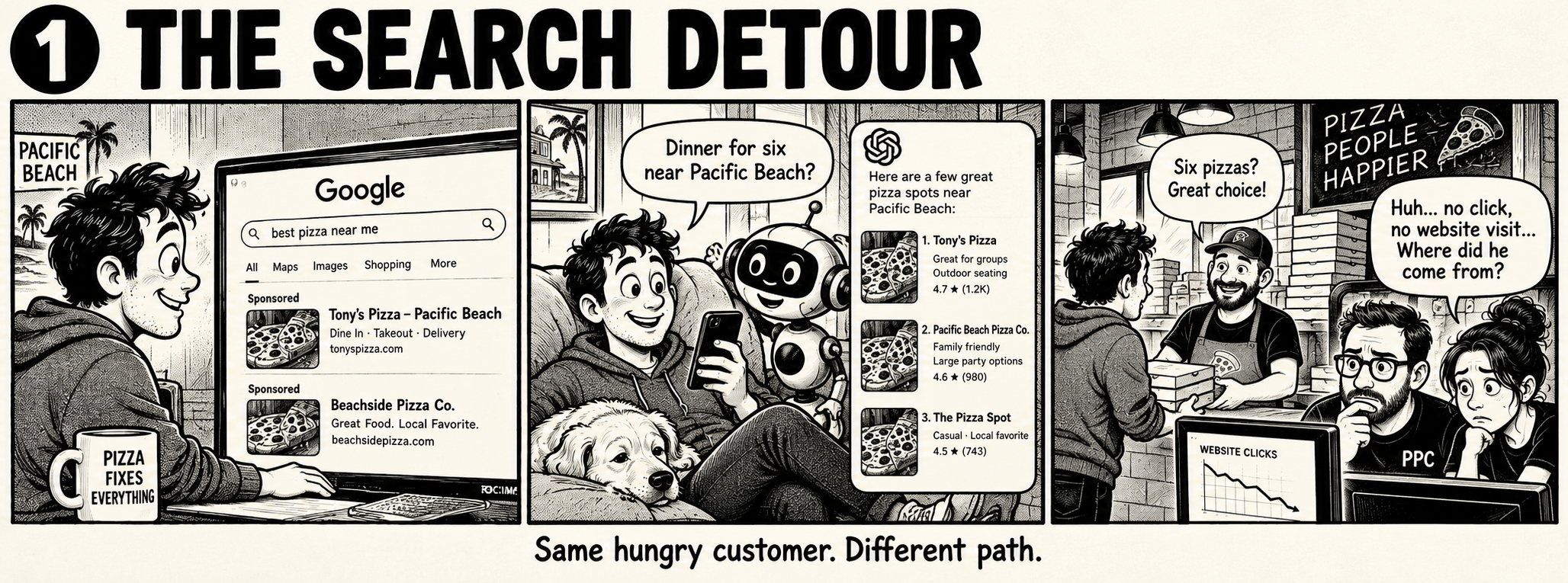
An Answer Is Not the Same Thing as a Click
Let’s say I need pizza for eight people in Pacific Beach.
The old search might be “pizza delivery Pacific Beach.” I’d see ads, check websites, compare menus, and place an order.
Now I can ask an assistant:
Find a good pizza place in Pacific Beach for eight people tonight. We need vegetarian options, delivery, and a family deal. Keep it under $120.
That’s a small purchasing assignment, not just a string of keywords.
The assistant might compare options, help narrow the choice, or send me to a restaurant, a map, or a delivery platform. The last step may still involve a website. It just doesn’t have to follow the familiar path.
There’s evidence of fewer clicks when Google itself supplies an AI summary.
In a July 2025 study, Pew found that Google users clicked a traditional search result on 8% of visits with an AI summary, compared with 15% on visits without one.
The study tracked browsing behavior from 900 U.S. adults. It did not isolate paid Google Ads clicks, and it does not establish that AI caused the difference in every individual search.
Still, it illustrates a meaningful change: a search can be useful even if no one clicks through to another website.
Useful for the customer. More complicated for a system built around advertising placements and clicks.
Did Google Shoot Itself in the Foot?
Maybe. But I wouldn’t say it that simply.
Google didn’t invent the demand for AI assistants. ChatGPT and other products showed people another way to ask questions, compare alternatives, and get things done.
Google could try to protect its traditional results page. Or it could change Search itself, even if that temporarily makes advertising harder to monetize.
It chose to change.
And now it has to solve a difficult economic problem.
A page of search results has familiar places for sponsored links. A conversational answer might be informational, comparative, or ready for a purchase. Sometimes the user is still exploring. Sometimes the answer is enough.
Where does the advertisement belong? When is it relevant? What is that moment worth? How will the advertiser know the customer bought something?
Google is already putting ads inside and alongside AI Overviews and AI Mode. Existing eligible Search, Shopping, and Performance Max campaigns can participate. But those experiences aren’t simply the old search results page with a robot pasted on top.
According to Google’s documentation, direct query matching and contextual matching have different eligibility. Broad match, AI Max, Shopping, and Performance Max can participate in contextual matching, while exact and phrase match keywords have more limited eligibility there.
More AI doesn’t mean advertising disappears. It means the auction and the customer’s journey are changing.
It’s Not Google Versus ChatGPT
This is where the easy headlines get it wrong.
We keep talking as if people must choose a side: Google or ChatGPT. Traditional search or AI search.
But people move between tools.
A Semrush clickstream analysis published in April 2026 reported that more than 20% of ChatGPT outbound referral traffic went to Google by early 2026.
That’s referral traffic, not a measure of all prompts or searches. Still, it suggests some people use one tool and then turn to another.
I think that’s a more useful model for marketers than declaring a winner.
A customer might discover a brand in a video, ask an AI to compare it with alternatives, check Google Maps, read reviews, and call without ever visiting the company website.
Trying to attribute every step perfectly will be difficult.
But pretending it all begins and ends with a Google Ads click won’t help either.
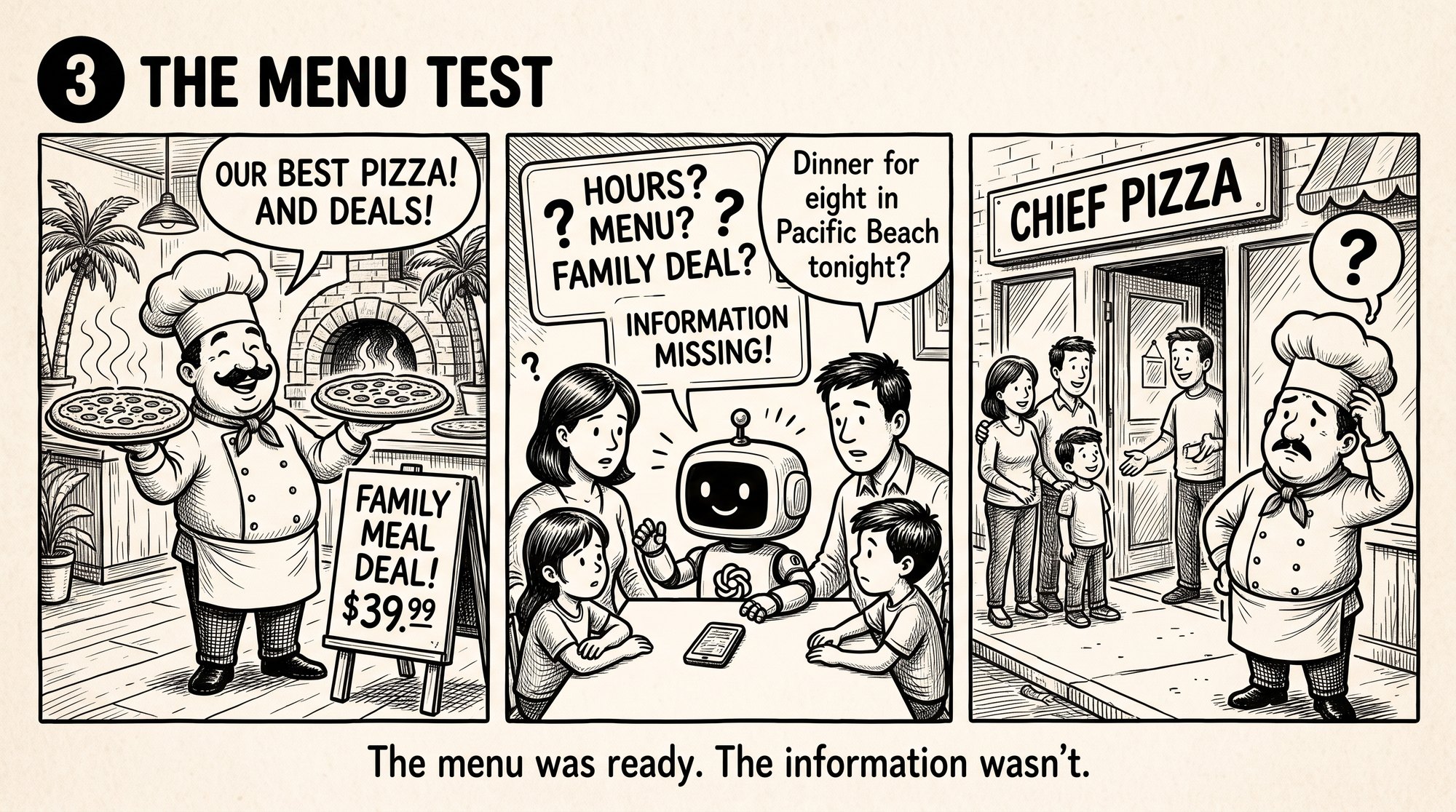
A Great Local Business Can Be Invisible to a Machine
Imagine a restaurant with genuinely good food, loyal customers, and a family special that makes it perfect for dinner with eight people.
Now imagine its online menu is outdated. Its family deal appears only on a paper flyer. Its hours don’t match across platforms.
An AI can only work with the information it can find and interpret. It might miss that restaurant even when the restaurant would be the right choice.
Nothing was wrong with the pizza.
The problem happened before anyone ordered.
The same issue can affect a hotel in Coronado with a particular amenity, a painting contractor who installs trim as well as painting it, or a boxing gym with an early morning class.
Those are illustrative scenarios, not findings from an audit of any Lead Wolf client.
The job is to compare what the business actually offers with what Google, AI assistants, maps, review platforms, and customers can reliably learn about it.
In our previous article, I called that difference the Gap.
Being Found Is Not the Same as Being Wanted
There’s another part of this that I find even more interesting.
Imagine two people looking for a boxing gym.
One asks an AI: “Find a good boxing gym in La Jolla.”
The other asks: “Find the schedule for PTC Boxing. I want to train there.”
Those are different marketing situations.
The first person needs a recommendation. The second has a preference.
Maybe a friend recommended the gym. Maybe they saw the coaches training, visited an event, or walked past it on their way to work.
Whatever created that preference happened before the search.
An AI can compare businesses. But when somebody wants a particular business, the comparison has already changed.
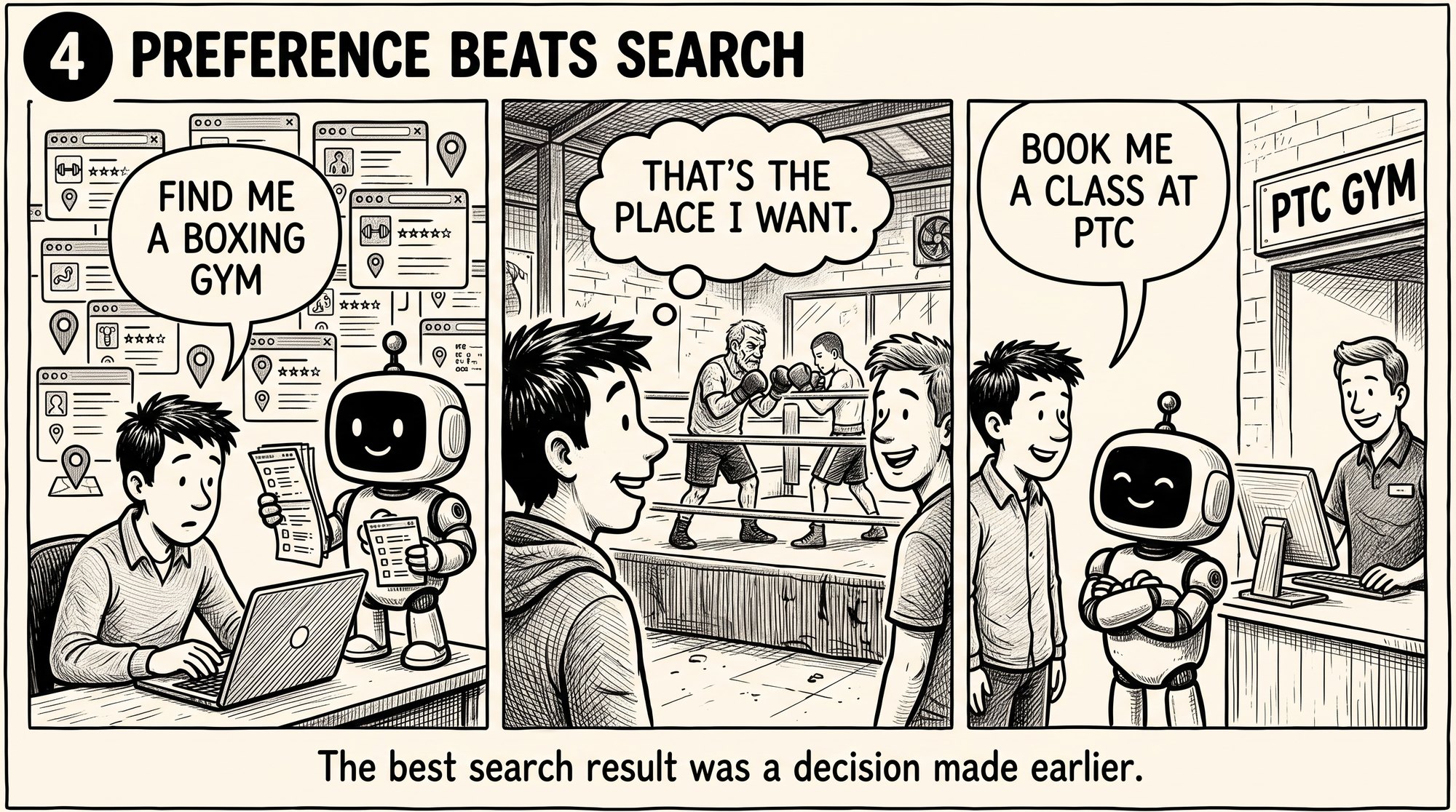
This is why I don’t think the future of marketing is just feeding more structured data to machines.
The business also has to matter to people.
Real experiences, photography, useful creative work, word of mouth, reputation, and a clear offer still count.
If AI makes comparison easier, memorable brands may have an even stronger reason to exist.
What I’d Change in the Marketing Budget
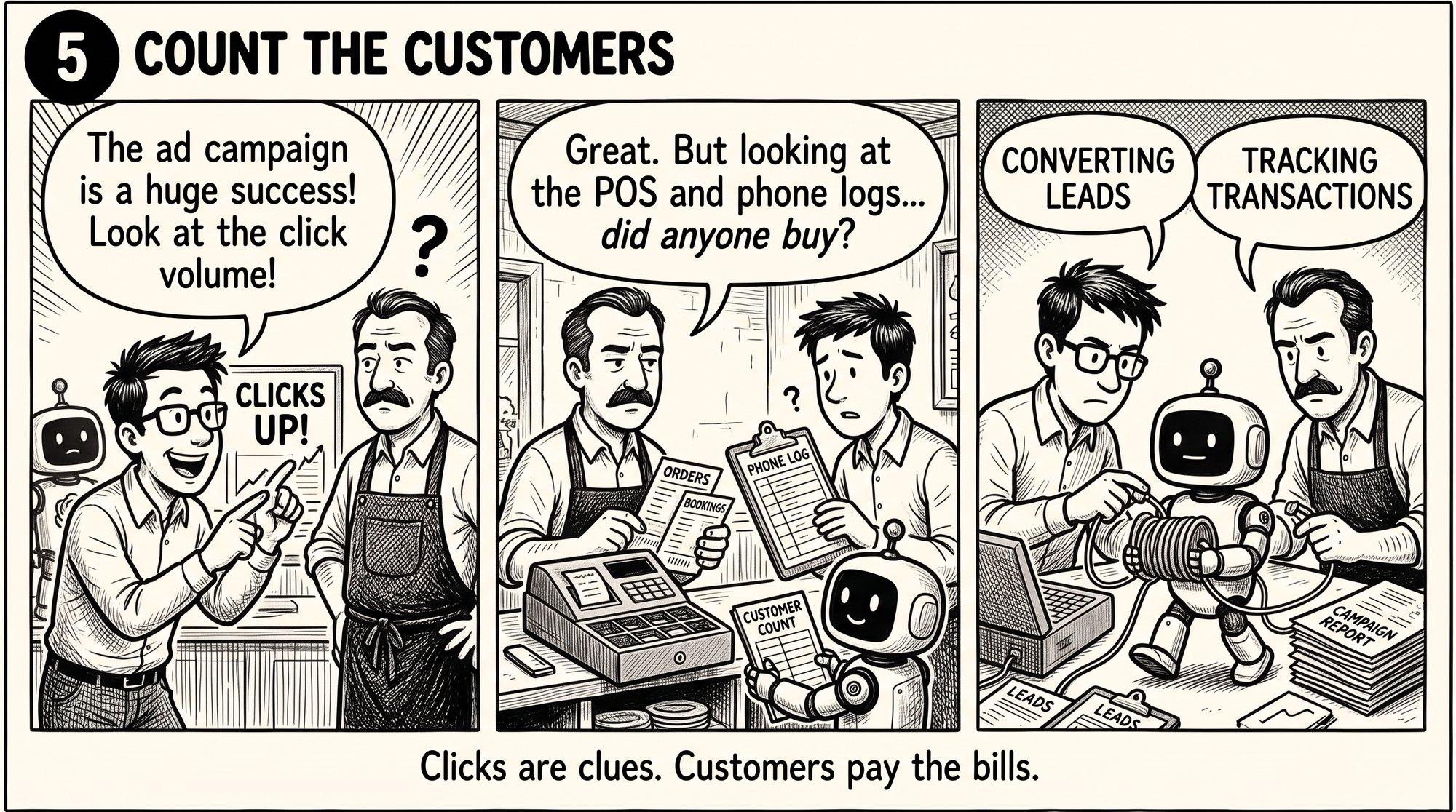
I wouldn’t turn off a profitable Google Ads campaign because Alphabet had a terrible Thursday.
I’d ask harder questions about what that campaign produces.
For a restaurant, how many verified orders came through the point of sale system, and which locations benefited?
For a service company, which phone calls turned into actual jobs?
For a hotel, what happened to bookings and revenue?
And for any business, where are people finding information that isn’t accurate or complete?
I’d keep effective high intent campaigns running, test new AI eligible approaches with proper controls, improve public business information, and compare performance using qualified leads and real sales whenever possible.
I’d also spend time creating reasons for people to recognize and prefer the business before searching.
A click can be useful evidence. It’s not the outcome we’re in business to produce.
What Happens Next?
I expect Google to keep experimenting with ads in AI responses and make AI Mode more commercial. It has already said it’s expanding ad experiments and agentic experiences that can help people complete actions such as bookings and purchases.
I expect AI assistants outside Google to keep influencing discovery and research, too.
What I don’t know is which interface will dominate, how much advertising will cost there, or how reliably a business will be able to measure it.
I don’t think anybody knows those answers with enough confidence to rebuild an entire business around one prediction.
So I’d keep working on three things we can actually test:
Preference. Do people know, remember, and want this business?
Readiness. Can AI accurately understand what it offers, where it operates, what it costs, and how somebody can buy?
Gap. Where does the machine’s understanding differ from reality?
This is a more durable way to respond than chasing every new “AI search hack” or abandoning channels that still bring in customers.
The Part That Hasn’t Changed
Nobody opens a restaurant because they want website clicks.
They want people ordering food, coming back, and telling their friends.
Nobody runs a boxing gym because they want better impressions.
They want people training.
And nobody buys advertising just to make a chart look impressive.
They want the right customers and a business that grows.
Google’s stock decline is the headline. The changing economics of search are the story underneath it.
People still have problems to solve, places to go, and things to buy. But the path between the question and the purchase is changing.
Our job is to understand that path, make sure the business can be found and understood, and measure whether it actually led to a customer.
Not just a click.
Oz | Lead Wolf
La Jolla, California
Sources
- Alphabet Q3 2026 earnings call transcript
- Alphabet CEO remarks, October 28, 2026
- Associated Press: Alphabet’s stock decline, October 29, 2026
- Pew Research Center: Americans and AI, June 2026
- Pew Research Center: AI summaries and website clicks, July 2025
- Semrush: ChatGPT search insights, April 2026
- Google Ads Help: Ads in AI powered Search