
AI is changing search, websites, PPC, and what it means to build a brand.
I’ve been thinking about websites lately. Not website design, not SEO, not whether your homepage needs another headline. I mean the actual reason websites exist.
For most of the internet era, the behavior has been simple: I need something, I search for it, I see some options, I click a website, I compare, I buy.
We built an entire marketing industry around that behavior. SEO gets you found. PPC puts you in front of somebody with intent. Creative gets attention. The website explains the offer and hopefully gets the customer to do something.
AI is starting to mess with that sequence. And I think that matters a lot more than another AI-generated ad.
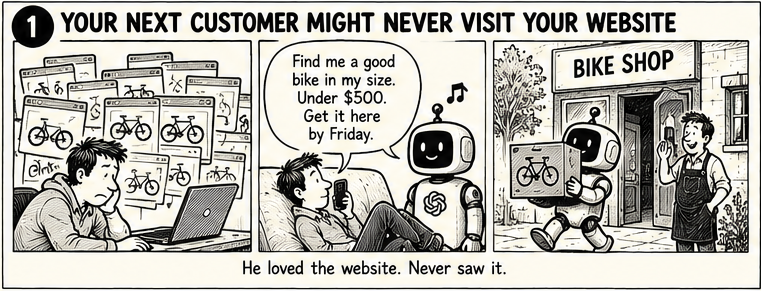
Think About How You Actually Buy Something
Let’s say I want a Megadeth shirt. Normally I’d search Google, open a few stores, look through the designs, check whether they’re officially licensed, compare prices, check shipping, close a few tabs, go back to one, and buy it.
But why do I need to do all of that myself? I can increasingly just tell an AI:
“Find me a black Megadeth shirt in my size. Officially licensed. Under $40. I need it before Friday.”
Now the machine does a large part of the shopping for me. It searches, compares, checks inventory, reads reviews, narrows the options — and increasingly, helps complete the transaction.
This part is no longer theoretical. OpenAI is already building product discovery around structured merchant catalogs inside ChatGPT. Google is building agentic commerce through Search, Gemini, Merchant Center, and its Universal Commerce Protocol.
So the question I keep coming back to isn’t “Will AI change websites?” Of course it will. The better question is:
What happens when the customer doesn’t need to visit your website first?
I Don’t Think the Website Dies
I think its job changes. The website used to be primarily a destination. Increasingly, it’s also infrastructure — a source of truth about the business:
- What do you sell, and what does it cost?
- Where are you, and are you open?
- Is it available? Can I book? Can I buy?
- What services do you provide?
- What do customers say about you?
- What are your policies?
A human needs to understand that information. Now a machine does too.
So no, I don’t think the website goes away. But we need to stop assuming the only important visitor is a person clicking around with a mouse.
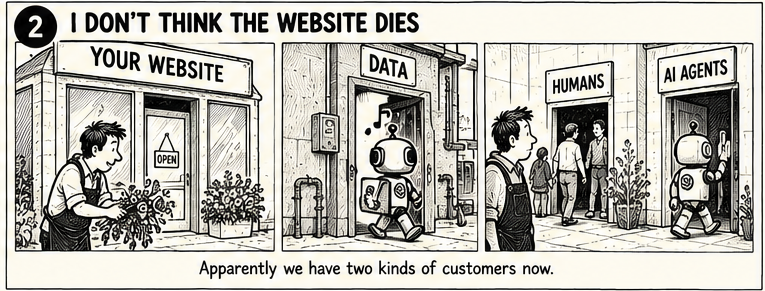
Now You Have Two Very Different Problems
This is where the idea got more interesting to me. At first I was thinking mostly about AI readiness: schema, structured information, feeds, APIs — making sure machines can understand the business.
That matters. But it’s only half the problem, because being understood is not the same thing as being wanted. Consider the difference between these two requests:
Starts a search
“Find me pizza.”
Starts with a decision
“Get me Mr. Moto.”
Those are completely different marketing outcomes. The first one begins a search. The second begins with a decision that has basically already been made. That’s human preference.
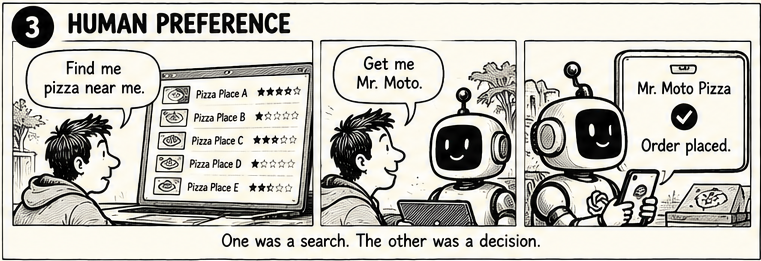
Human Preference
People don’t make decisions using information alone. We remember things. We associate businesses with experiences, people, places, culture, identity, design, reputation, and stories. Sometimes politics. Sometimes status. Sometimes nostalgia. Sometimes something as simple as “I like that place.”
That’s why branding exists. And strangely, I think AI could make this part of marketing more important, not less.
If an AI can compare fifty businesses for me in seconds, being the fifty-first business with slightly better website copy isn’t much of an advantage. But if I specifically ask for you, that’s different. The machine is no longer deciding between fifty options. I already made the decision.
One of the most important jobs in marketing may become creating enough memory, trust, identity, and experience that people ask for the brand by name.
Then There Is AI Readiness
Now the other side. Your business can be great in real life and still look mediocre to a machine.
Imagine a restaurant everybody in the neighborhood loves. Great food, great people, regular customers, a strong local reputation. But online, the hours are wrong, the menu is old, pricing is missing, and the descriptions don’t match across platforms. The website says one thing, Google says another, and reviews mention services that no longer exist.
Now somebody asks an AI:
“Find me somewhere nearby for six people tonight with vegetarian options.”
Your restaurant might be perfect. But if the system can’t establish that confidently, you may never become one of the options. That’s AI readiness.
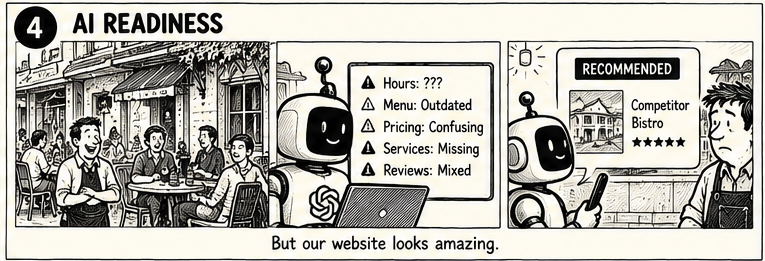
It isn’t glamorous work. It’s digital hygiene: accurate information, clear services, pricing, availability, reviews, locations, policies, schema, structured data, merchant feeds, and consistent information across platforms. Eventually, more APIs and agent protocols.
Boring? A little. Important? Very. The machine can’t prefer a business it can’t properly understand.
Then There Is the Gap
This might be the part I’m most interested in. Ask ChatGPT about your company. Then ask Gemini. Then ask Google. Don’t ask marketing questions — ask customer questions:
- What does this company actually specialize in?
- Who are they for?
- Are they expensive?
- Can they do this?
- What makes them different?
- Would they be a good choice for this particular situation?
Then compare the answers with reality. That difference is the Gap.
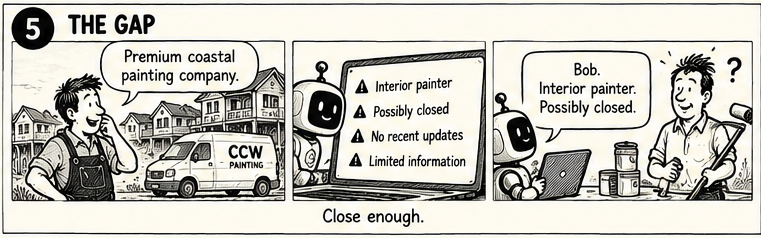
Sometimes the problem is obvious: wrong hours, wrong location, a missing service, old information. But sometimes the machine will be technically correct and still completely misunderstand the business. That’s more interesting.
Maybe it knows what you sell but not why people buy from you. Maybe it describes you as a production company when most of your value comes from strategy. Maybe it knows a restaurant sells pizza but misses its place in the neighborhood. Maybe it understands the product but not the customer.
Now we’re getting beyond rankings. We’re measuring the difference between the company that actually exists and the company machines think exists. I think closing that gap is going to become real marketing work.
What Happens to SEO?
SEO doesn’t disappear. The job gets wider.
Traditional SEO asks: how do we get this page discovered and ranked? The next layer asks: can these systems correctly understand this business and retrieve it when somebody asks the right question?
Those problems overlap, but they aren’t the same. The website still matters. Technical SEO, original information, authority, reviews, and structure all still matter. The difference is that sometimes the result of all that work won’t be a traditional blue link. It may be part of an answer.
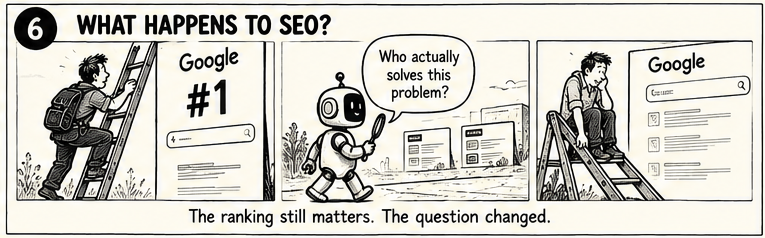
So I don’t buy the idea that AI suddenly kills SEO. I think it adds another layer. Search has done this before — maps, images, video, featured snippets, local results, shopping. AI becomes another interface. Except this interface can increasingly reason, compare, and act. That part is new.
What Happens to PPC?
This one hits close to home. I’ve been working in PPC for more than a decade, and a lot of what used to require a specialist is becoming automated: keyword expansion, bidding, audience discovery, creative variations, reporting, budget recommendations, performance analysis.
So I have to ask an uncomfortable question: if the machine gets very good at operating the advertising system, what exactly are we getting paid for?
I don’t think the answer is “knowing where all the buttons are in Google Ads.” That’s probably a losing bet.
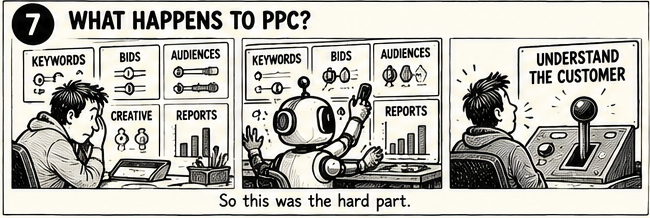
The value moves upstream:
- Understanding the business, the customer, the offer, and why somebody buys.
- Knowing when the creative is the problem — or the offer, or the sales team.
- Knowing when the data is lying.
- Knowing what the machine should actually optimize toward.
That’s a very different job from running ads. And frankly, I think it’s a better one. AI can increasingly operate the marketing system. Our job becomes deciding what that system should understand about people, what the evidence actually means, and how the business should respond.
AI Might Make Real Things More Valuable
Here’s another possibility I keep coming back to. AI is going to produce an unbelievable amount of content — images, video, copy, music, ads. A lot of it will be terrible. A lot of it will also be perfectly competent.
That creates an interesting economic problem. If competent content becomes nearly unlimited, it becomes less scarce. So what becomes scarce?
Reality.
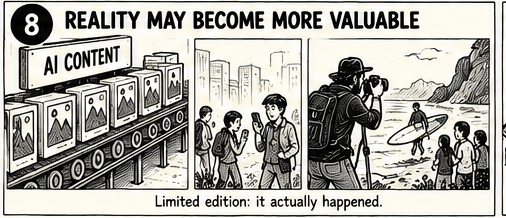
A real person. A real customer, chef, boxer, or founder. A real location. A real event. A photograph of something that actually happened. A story that exists because somebody lived it.
I don’t know exactly how far that goes, and I’d be careful about claiming some giant “authenticity revolution” before we have evidence. But I think there’s a reasonable possibility that the more synthetic the internet becomes, the more valuable some forms of real human experience become.
That matters to us at Lead Wolf, because on paper our services can look strangely disconnected. We work with AI. We run paid media. We diagnose businesses. We also have cameras, lights, production equipment, directors, editors, and an actual studio.
I increasingly think those things belong together. One side helps machines understand the business. The other helps human beings care about it.
Preference. Readiness. Gap.
This is the framework I’m working with right now. Not because I’ve figured out the future of marketing — I haven’t, and nobody has — but because it gives us a practical way to work through it.
Preference
Do people know you, remember you, trust you, and want you specifically?
Readiness
Can AI accurately understand what you do, what you sell, who you’re for, and when you’re relevant?
Gap
Where does the machine’s understanding of your business differ from reality?
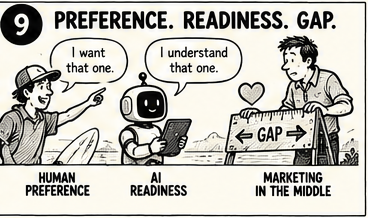
That last piece is where I think an entirely new type of marketing work may be emerging. Not manipulating ChatGPT into mentioning your company. Not inventing another acronym. Not selling businesses some new version of “AI SEO hacks.”
Actually testing what machines understand about a company. Finding what’s incomplete, inaccurate, or invisible. Then fixing it.
Don’t Bet the Company on One Version of the Future
This is probably the most useful conclusion I’ve reached. I wouldn’t rebuild Lead Wolf around one prediction about AI. It’s too early, and too much is changing.
Instead, I want to build capabilities that work across several possible futures: make businesses more memorable to humans, make them easier for machines to understand, measure the gap between the two, and keep testing. That seems more durable than rebuilding the company every time another AI tool launches.
So that’s where we’re starting. Three questions:
- Do humans prefer you?
- Can AI understand you?
- What is the gap between the two?
We’re going to start testing this against actual businesses. Then we’ll see what the machines get right, what they get wrong, and what happens when we fix it.
That part should be interesting.
Oz — Lead Wolf